
NB! Information on this site is subject to change. More detailed information will be updated for spring 2027.
The International UAS Exam is a joint digital entrance exam of the Finnish Universities of Applied Sciences (UAS), used for selecting students to study programmes leading to a bachelor’s degree and conducted in English. The entrance exam is completed by the applicant’s own computer remotely online.
The International UAS Exam is organised on 23 March 2027 from 12:00 o’clock noon onwards (Finnish time, UTC/GMT+2). In the International UAS Exam, the applicants’ readiness for UAS studies is assessed. The exam does not include any advance reading materials or pre-assignments.
The International UAS Exam is used in the following study fields:
- Humanities and Education
- Business Administration, Business Information Technology (BIT)
- Natural Resources
- Tourism and Hospitality
- Seafaring
- Social Services, Health Care, Sports and Exercise, Beauty Care
- Technology
Language requirements
NB! Information is subject to change.
All applicants of the University of Applied Sciences’ Bachelor’s programmes, including native speakers of English, must demonstrate their English language proficiency. Details on the accepted methods for proving language proficiency are available on this site. Be sure to review the requirements carefully.
To get invited to the International UAS Exam and be selected by the International UAS Exam selection method, the applicants have to prove their English language skills either by an internationally recognized language test or previous studies.
Additionally, to be selected through the certificate-based selection method on matriculation examination and vocational upper secondary qualification, applicants must also prove their English language skills.
Please attach the required document to your Studyinfo application on 28 January 2027 at 15:00 Finnish time (UTC/GMT+2) at the latest.
Identification documents
NB! Information is subject to change.
The applicant needs a valid, acceptable identification document to be able to participate in the International UAS Exam. The passport/identity card has to be valid until 12 March 2027.
The following documents are accepted as proof of identity:
- Passport (preferred option)
- The passport can be either biometric or non-biometric
- If you have a passport, use it, as valid passports are always accepted as proof of identity
- Passports from all countries are accepted as proof of identity
- Biometric EU/EEA identity card
- If you do not have a passport but you have a biometric identity card from an EU/EEA country, it is accepted as proof of identity
- The EU/EEA identity card must have a biometric symbol, as shown below
No other forms of identification documents are accepted. For example, residence permit cards, non-biometric EU/EEA identity cards or identity cards issued by non-EU/EEA countries will not be accepted.
You must be identifiable from the photo on your passport or identity card. Note this especially if it has been a long time since the passport or identity card was issued. You must use your original physical identification document for the pre-identification in the Candour ID application; a photo or copy of your identification document is not acceptable.
Example of the symbol, the colour of which may vary between different EU/EEA countries' identity cards.

For the identification process, you have to submit the following information on the Studyinfo application form:
- A copy of a valid passport or biometric EU/EEA identity card during the application period or by 28 January 2027 at 15:00 Finnish time (UTC/GMT+2) at the latest.
- If you are using a biometric EU/EEA identity card, you must attach a copy of both sides of the identity card to your application form.
- During the application period: The number of the passport or biometric EU/EEA identity card you have attached to the application form.
- Ensure that the passport or identity card number is written correctly. It is the responsibility of the applicant to provide the correct passport or identity card number.
- If the passport or identity card number contains letters, write them in UPPERCASE.
- Use the same passport or biometric EU/EEA identity card for the pre-identification in the Candour ID application as the one whose number was provided in your Studyinfo application form in the section “Passport or biometric EU/EEA ID card (UAS)”. Using a different identification document may result in your pre-identification being rejected, and you may not be able to proceed with the International UAS Exam process.
- If needed, you can update the identification document number to your Studyinfo application by 19 February 2027. In this case, submit a new identification document attachment to the Admissions Services of the university of applied sciences listed as your highest choice on your application, using the International UAS Exam. Please take this into account, for example, if you have renewed your passport.
- See below for detailed instructions on how to find the passport or identity card number on the document.
If the information you submit is incorrect or you do not submit this information to the application by the given time limit, you cannot participate in the International UAS Exam and thus not proceed in the International UAS Exam selection process.
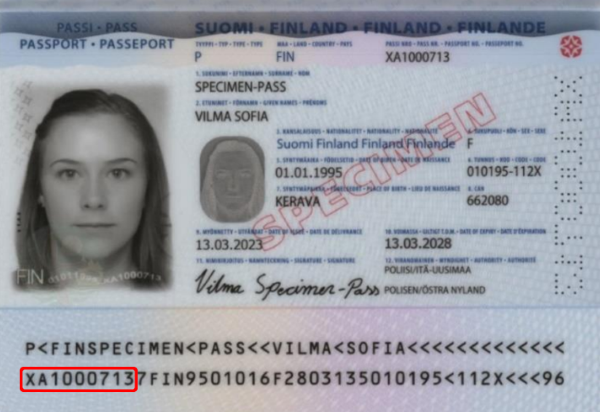
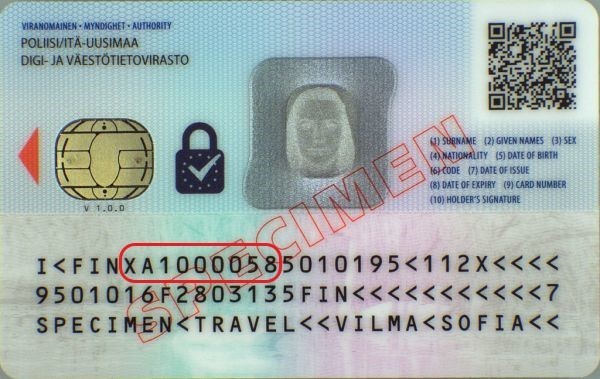
The biometric EU/EEA identity card number may be located in different fields on different national identity cards. The biometric EU/EEA identity card number is typically located in the field labeled "Document number" or "Card number", but it can also be located in other fields. You can verify the correct identity card number from the machine-readable zone (MRZ) on the reverse side of the identity card. The identity card number is located on the first line of the MRZ, starting from the 6th character, see the picture below.
Exam sections, duration and scoring
More detailed information will be updated for spring 2027.
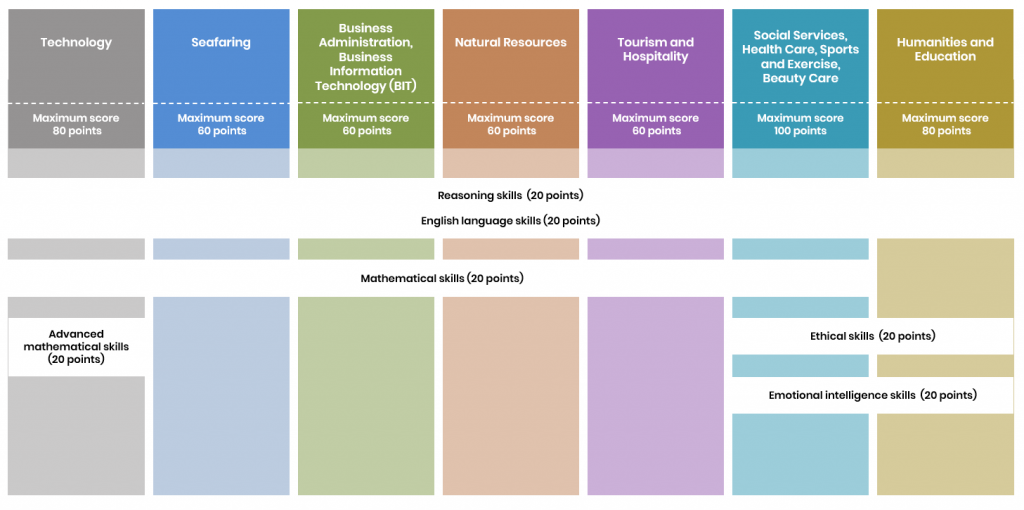
The entrance exam is conducted in the English language. The exam sections and duration of the exam are determined on the basis of the study programmes you apply for. You complete at one time all the exam sections that are included to the study programmes you apply for. The entrance exam includes both common exam sections to all study programmes and field-specific exam sections. The exam sections for each study field are presented in Chart 1. A total score of the exam is the sum score of the exam sections included to your study programme. In order to be selected, you must pass all the exam sections (i.e. reach the minimum pass score per section).
A specific response time has been allocated for each exam section. When the section-specific time is up, the section will close. If you don’t finish the section, its latest version will be saved as your answer. You can complete the sections in any order. Please note that once a section is opened, it needs to be completed, and you cannot return to the section later. In addition to the section-specific times, there is 15 minutes for transitions between sections in the exam.
Common exam sections to all study programmes:
- Reasoning skills (25 minutes): You have to complete this exam section regardless of the programme you apply for. The section assesses your logical reasoning and problem-solving skills. Please have a look at the reasoning skills sample questions.
- English language skills (20 minutes): You have to complete this exam section regardless of the programme you apply for. The section assesses your skills in reading and interpreting texts, such as understanding the relation between different parts of the text, mastering vocabulary and linguistic reasoning. Please have a look at the English language skills sample questions.
Field-specific exam sections:
- Mathematical skills (25 minutes): This exam section is required for the fields of Technology, Business Administration and BIT, Natural Resources, Tourism and Hospitality, Seafaring, Social Services, Health Care, Sports and Exercise and Beauty Care. The contents of the section are the same for all the above-mentioned fields. In this section, your basic mathematical skills are assessed. The focus is on basic calculations, calculating percentages, first-degree equations, geometry, mathematical-logical reasoning and interpreting tables, graphs and diagrams. In this section, you are allowed to use the exam system’s built-in calculator. Please have a look at the mathematical skills sample questions.
Introduction
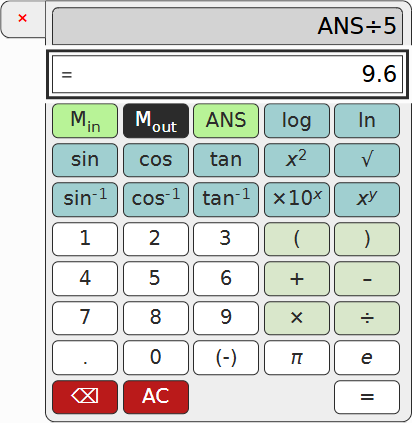
The exam system built-in calculator is available when you are allowed to use a calculator to complete tasks. In sections where the calculator is available, the Calculator button appears on the right-hand side of the applicant's view. The calculator is opened by clicking the button. The calculator can also be opened and closed using a keyboard shortcut or the keyboard.
Calculator’s functions in the exam system:
- addition, subtraction, multiplication and division
- brackets
- squares and square roots
- power of ten and general power
- trigonometric functions (angle values in degrees)
- natural logarithm (ln) and common logarithm (log)
- constant numbers π and e
- result of the previous calculation in the ANS button
- storing the value of an expression in memory Min and reading the value from memory Mout
Using the calculator
Opening and closing the calculator during the exam The calculator can be opened by clicking the Calculator button on the right-hand side of the applicant's view (or by pressing Shift + Alt + L or Cmd + Shift + L). The calculator can be hidden by clicking the x symbol on the left-hand side of the open calculator (or by pressing Shift + Alt + L or Cmd + Shift + L). The buttons for opening and closing the calculator can also be accessed using the keyboard (tab navigation).
Hiding the calculator does not delete the calculation on the calculator screen. Calculations can be partially entered using the keyboard.
Entering expressions and performing calculations
Expressions can be entered in three different ways:- Using the computer keyboard
- The Pi (π) and square root (√) symbols cannot be entered using the keyboard
- Expressions are executed by pressing Enter when the focus is on the input field
- The input field is cleared with the Esc key (corresponds to the AC button on a calculator)
- Exponentiation with the ^ symbol, input example: 5^2
- Inputting the functions sin, cos, tan, asin, acos, atan, ln and log, for example: sin(30) and atan(1)
- By clicking the calculator buttons with the mouse
- The selected symbols are added to the expression in the input field
- The expression is executed by clicking the equal sign
- By navigating with the arrow keys on the computer keyboard
- Switching between the input field and the calculator keyboard: tab / shift-tab
- Confirm your selection with the enter button
- The expression is executed by navigating to the equal sign and pressing enter
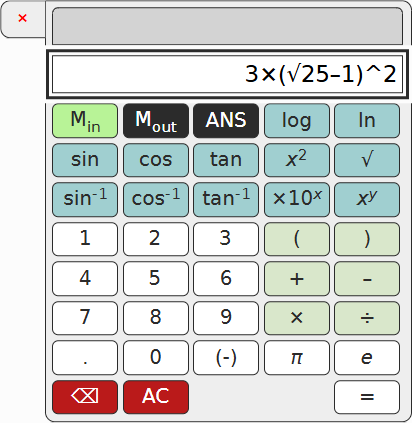
After executing the expression, the input is transferred to the top row of the calculator and the result to the bottom row.
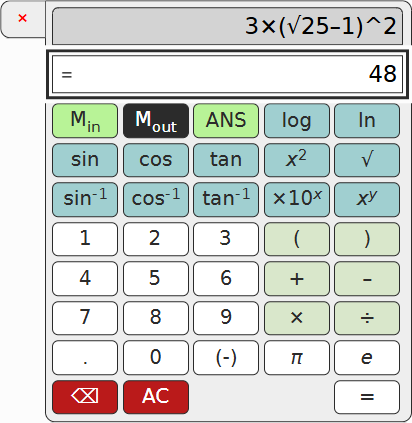
After the calculation, it is possible to- Start entering a new expression. The expression and result are deleted when you start typing a new entry. If the entry after ‘=’ starts with:
- the operators +, -, /, * or an exponent: ANS(*) and the entered operation are recorded as the entry. E.g. + → ANS+.
- Note: the symbol ‘-’ entered on the keyboard is interpreted as a prefix in the new expression, not as an operator!
- another symbol: the expression is replaced with the entered symbol. E.g. 5 → 5 or cos → cos(
- the operators +, -, /, * or an exponent: ANS(*) and the entered operation are recorded as the entry. E.g. + → ANS+.
- Return the calculated/executed expression for editing by clicking on the expression. The expression is transferred to the input field. Alternatively, you can return the expression by navigating to the relevant field using the keyboard (shift+tab) and pressing enter.
- Advanced mathematical skills (30 minutes): This exam section is required for the field of Technology. The section assesses your abilities in mathematics and physics. Your mathematical skills are assessed by questions related to reducing rational expressions, solving equations, level geometry and trigonometry (e.g. right-angled triangle). Your physics skills are assessed by questions related to basic knowledge in physical phenomena and calculation formulas, your ability to calculate and reason on the basis of basic physical knowledge and given models, and your ability to interpret charts, graphs and diagrams. In this section, you are allowed to use the exam system’s built-in calculator. Please have a look at the advanced mathematical skills sample questions.
Introduction
The exam system built-in calculator is available when you are allowed to use a calculator to complete tasks. In sections where the calculator is available, the Calculator button appears on the right-hand side of the applicant's view. The calculator is opened by clicking the button. The calculator can also be opened and closed using a keyboard shortcut or the keyboard.
Calculator’s functions in the exam system:
- addition, subtraction, multiplication and division
- brackets
- squares and square roots
- power of ten and general power
- trigonometric functions (angle values in degrees)
- natural logarithm (ln) and common logarithm (log)
- constant numbers π and e
- result of the previous calculation in the ANS button
- storing the value of an expression in memory Min and reading the value from memory Mout
Using the calculator
Opening and closing the calculator during the exam The calculator can be opened by clicking the Calculator button on the right-hand side of the applicant's view (or by pressing Shift + Alt + L or Cmd + Shift + L). The calculator can be hidden by clicking the x symbol on the left-hand side of the open calculator (or by pressing Shift + Alt + L or Cmd + Shift + L). The buttons for opening and closing the calculator can also be accessed using the keyboard (tab navigation).
Hiding the calculator does not delete the calculation on the calculator screen. Calculations can be partially entered using the keyboard.
Entering expressions and performing calculations
Expressions can be entered in three different ways:- Using the computer keyboard
- The Pi (π) and square root (√) symbols cannot be entered using the keyboard
- Expressions are executed by pressing Enter when the focus is on the input field
- The input field is cleared with the Esc key (corresponds to the AC button on a calculator)
- Exponentiation with the ^ symbol, input example: 5^2
- Inputting the functions sin, cos, tan, asin, acos, atan, ln and log, for example: sin(30) and atan(1)
- By clicking the calculator buttons with the mouse
- The selected symbols are added to the expression in the input field
- The expression is executed by clicking the equal sign
- By navigating with the arrow keys on the computer keyboard
- Switching between the input field and the calculator keyboard: tab / shift-tab
- Confirm your selection with the enter button
- The expression is executed by navigating to the equal sign and pressing enter
After executing the expression, the input is transferred to the top row of the calculator and the result to the bottom row.
After the calculation, it is possible to- Start entering a new expression. The expression and result are deleted when you start typing a new entry. If the entry after ‘=’ starts with:
- the operators +, -, /, * or an exponent: ANS(*) and the entered operation are recorded as the entry. E.g. + → ANS+.
- Note: the symbol ‘-’ entered on the keyboard is interpreted as a prefix in the new expression, not as an operator!
- another symbol: the expression is replaced with the entered symbol. E.g. 5 → 5 or cos → cos(
- the operators +, -, /, * or an exponent: ANS(*) and the entered operation are recorded as the entry. E.g. + → ANS+.
- Return the calculated/executed expression for editing by clicking on the expression. The expression is transferred to the input field. Alternatively, you can return the expression by navigating to the relevant field using the keyboard (shift+tab) and pressing enter.
- Ethical skills (10 minutes): This exam section is required for the fields of Social Services, Health Care, Sports and Exercise, Beauty Care, and Humanities and Education. The contents of the section are the same for all the above-mentioned fields. In this section, your skills in recognising the ethical nature of statements are assessed. Please have a look at the ethical skills sample questions.
- Emotional intelligence skills (10 minutes): This exam section is required for the fields of Social Services, Health Care, Sports and Exercise, Beauty Care, and Humanities and Education. The contents of the section are the same for all the above-mentioned fields. In this section, your capabilities in emotional intelligence skills, such as recognizing and controlling emotions, are assessed. Please have a look at the emotional intelligence skills sample questions.
Chart 1. Exam sections.
Identification process
NB! Information is subject to change. More detailed information will be updated for spring 2027.
You have to identify yourself to be able to participate in the International UAS Exam and proceed in the International UAS Exam selection process.
The identification process consists of two phases: 1) pre-identification and 2) identification on the exam day.
1. Pre-identification (before the exam)
Before the exam, you have to perform the pre-identification in the Candour ID mobile application during the period from 10 March 2027 at 8:00 Finnish time (UTC/GMT+2) to 12 March 2027 at 15:00 Finnish time (UTC/GMT+2).
You can check the status of your pre-identification anytime by logging in to the page https://login.uasexam.fi/ using your passport or biometric EU/EEA ID card number and the PIN you chose in your application.
You can perform the pre-identification via the login page (https://login.uasexam.fi/). You will also receive an invitation to the pre-identification to the email address provided on your Studyinfo application form. Please note that the delivery of the email may take some time. The email will be sent only once so please make sure that you have space in your inbox. If necessary, also check your spam and other folders. If you can’t find the invitation to the pre-identification in your email, you must proceed with the pre-identification via the login page.
In the login page, please submit the same passport or biometric EU/EEA ID card number as provided in the “Passport or biometric EU/EEA ID card (UAS)” section, and the same PIN code as in the “International UAS Exam selection method” section of your Studyinfo application. If you don’t remember your PIN code, please check it from your own Studyinfo application.
Only those applicants who have submitted an acceptable proof of English language skills, an approved identification document via the Studyinfo application form, and paid the application fee (if required) by the deadline can perform the pre-identification.
You need the following for the pre-identification:
- Passport or biometric EU/EEA identity card. The passport/identity card has to be valid until 12 March 2027.
- Perform the pre-identification using the same passport or biometric EU/EEA identity card as the one whose number was provided in your Studyinfo application in the section “Passport or biometric EU/EEA ID card (UAS)”. Using a different identification document may result in your pre-identification being rejected, and you may not be able to proceed with the International UAS Exam process. Please note that residence permit cards, non-biometric EU/EEA identity cards, or identity cards issued by non-EU/EEA countries will not be accepted.
- You must use your original physical identification document for the pre-identification in the Candour ID application; a photo or copy of your identification document is not acceptable.
- You must be identifiable from the photo on your passport or identity card. Note this especially if it has been a long time since the passport or identity card was issued.
- A mobile phone with the Candour ID application installed (available in App Store or Google Play). Make sure you have the latest version of the application installed.
2. Identification on the exam day
Those applicants who have successfully performed the pre-identification will be able to participate in the exam. On the exam day, you have to identify yourself again while logging in to the exam. This means that you will first proceed to the Candour’s service to take a selfie with your computer’s camera.
Performing the pre-identification on 10-12 March 2027
More detailed information will be updated for spring 2027.
The Candour ID mobile application is used for identification. The pre-identification has to be performed from 10 March 2027 at 8:00 Finnish time (UTC/GMT+2) to 12 March 2027 at 15:00 Finnish time (UTC/GMT+2). If you do not perform the pre-identification within the given timetable, you cannot be invited to the International UAS Exam, and you cannot proceed in the exam selection process.
Monitoring
More detailed information will be updated for spring 2027.
Your activities during the exam are monitored in the exam system by SMOWL CM proctoring software. SMOWL CM proctoring software stores frontal and external camera images, screenshots of your computer screen, audio recordings, and all computer activities during the exam, including visited websites and opened applications. The software also identifies any peripherals or external devices connected to the computer. Monitoring ensures that the applicant completes the exam independently, without the help of anybody or anything else.
If you need help with the use of SMOWL, please find more information on SMOWL’s website.
You need to download and install SMOWL CM well before the exam. You will receive the download link for SMOWL CM by email once your pre-identification is completed successfully. Alternatively, the download link is available on the login page (https://login.uasexam.fi/) once your pre-identification is completed successfully. Please note that the download link is personal and should not be shared. If you have already installed SMOWL CM, make sure you have the latest version updated well before the exam.
Monitoring during the exam
More detailed information will be updated for spring 2027.
Guidelines for exam completion
More detailed information will be updated for spring 2027.
Participating in the exam and exam schedule
More detailed information will be updated for spring 2027.
The International UAS Exam is organised on 23 March 2027 from 12:00 o’clock noon onwards (Finnish time, UTC/GMT+2).
Note: Finland changes between standard time (UTC+2) and daylight saving time (UTC+3). On 23 March 2027, Finland is on standard time (UTC+2).
Make sure to convert your local time accurately to Finnish time to avoid being late for your exam. The exam is organised only once on 23 March and cannot be completed at another time.
Logging in to the exam
You can log in to the exam on the exam day through the login page: https://login.uasexam.fi/. When logging in, please submit the same passport or biometric EU/EEA ID card number as provided in the “Passport or biometric EU/EEA ID card (UAS)” section, and the same PIN code as in the “International UAS Exam selection method” section of your Studyinfo application. If you don’t remember your PIN code, please check it from your own Studyinfo application.
NB: Only those applicants who have successfully performed the pre-identification will be able to log in to the exam through the login page.
Invitation to the exam
In addition to the login page, on 22 March 2027 at the latest, you will receive an invitation to the exam to the email address you provided in your Studyinfo application. The invitation includes a personal login link to the exam. Please note that the link is personal and should not be shared. The email will be sent only once so please make sure that you have space in your inbox. If necessary, also check your spam and other folders.
If you can’t find the invitation to the exam in your email, you must read the important exam information provided in the invitation via the login page (https://login.uasexam.fi/), starting from 22 March. On the exam day you must log in to the exam via the login page.
NB: The invitation to the exam will be sent only to those applicants who have successfully performed the pre-identification
Identification on the exam day
On the exam day, you must identify yourself again during exam login. When logging in, you will first proceed to Candour’s service and take a selfie using your computer’s camera. The person in the selfie must be recognizable as the same person whose facial image was captured during the pre-identification.
When taking a selfie, make sure you have adequate light conditions and that your face is clearly visible and the selfie you take is sharp.
- Do not have bright lights, windows, or light sources directly behind you. Backlighting can make your face appear dark or unclear.
- Avoid light reflections on your face, glasses, or screen, as they can interfere with facial recognition.
- Do not use any filters or effects on your camera image. These may lead to automatic rejection during the identity verification process.
You have three attempts to identify yourself.
- If your identification fails three times due to poor image quality (for example blurry, grainy or too dark selfies), you will still be allowed to proceed to the exam. In this case, your exam identification will be reviewed manually after the exam. If your identity cannot be reliably confirmed from the selfies, your identification and your exam result may be rejected.
- If your exam result is dismissed because your identification is not accepted after the manual review, you will see this information in the Entrance Exam Score Service when the results are published.
- If your identification fails for reasons other than poor image quality, you will not be allowed to proceed to the exam after three failed attempts.
We recommend testing your computer camera in advance, as it is required for identification and helps avoid technical issues during login. You can access the camera test tool here: https://portal.candour.fi/cameraTest
Preparations for SMOWL monitoring
Information will be updated for spring 2027.
Hardware and network requirements
More detailed information will be updated for spring 2027.
NB! Hardware requirements are subject to updates; please check the detailed instructions before participating in the exam.
The International UAS Exam is a digital exam, completed by the applicant’s own desktop computer or laptop. You cannot complete the exam with a mobile phone or tablet. For more detailed instructions on prohibited and allowed devices during the exam, please see the exam guidelines section.
Use the up-to-date version of the Chrome browser. In case of problems, you can try using an updated version of the Microsoft Edge browser. Please do not use other browsers.
Please ensure that, on the day of the exam, you have access to a computer that meets the requirements and has a reliable internet connection. We recommend the use of a fixed broadband connection. The applicant is responsible for the functionality of the internet connection and the computer, including its power supply. The universities of applied sciences cannot be held responsible for problem situations related to taking the exam, due to applicant’s hardware or software, or the stability of the internet connection.
We recommend that you use a mouse to navigate in the exam system instead of the keyboard.
Privacy policy
The applicant performs the pre-identification in the Candour ID application. If the applicant does not succeed with the pre-identification in the Candour ID application, their pre-identification will be forwarded for manual review. In the manual process, the applicant’s pre-identification data is reviewed by Vallu entrance examination service operators and, based on this review, the applicant’s pre-identification is either approved or rejected. During the pre-identification, Candour forwards the facial image of the applicant to Vallu entrance examination service. In the identification on the exam day, the selfie taken by the applicant is compared to the facial image stored during the pre-identification. The purpose of identification is to verify the applicant’s identity. The data collected during the exam will be stored only for the necessary time period after the exam. Collecting and storing data is compatible with the European General Data Protection Regulation (GDPR). The servers are located in the European Union.
Vallu entrance examination service forwards the applicant’s name and email address, and the facial image of the applicant captured during the pre-identification to SMOWLtech via a technical interface. The facial image is used in SMOWL proctoring software as a registration image and during the exam as a reference image for SMOWL monitoring, against which images taken by the frontal camera and external camera during monitoring are compared.
SMOWL CM proctoring software stores frontal camera and external camera images, screenshots of applicant’s computer screen, audio recordings, and all computer activities during the exam, including visited websites and opened applications. The purpose of monitoring is to ensure that the applicant completes the exam independently, without the help of anybody or anything. Monitoring is conducted automatically during the exam to secure legal protection and parity of applicants. The applicant may refuse monitoring or interrupt it. Refusing or interrupting monitoring means that the applicant may not be selected by the International UAS Exam selection method. After the exam, the applicants’ monitoring data is reviewed by Vallu entrance examination service operators and, based on this review, applicants may be dismissed if they have acted contrary to the guidelines for exam completion. The data stored during the entrance exam will be stored only for the necessary time period after the entrance exam. Collecting and storing data is compatible with the EU’s General Data Protection Regulation (GDPR). The servers are located in the European Union.
- More information on Candour’s privacy policy
- More information on SMOWL’s privacy policy
- More information on Vallu entrance examination service’s privacy policy
Frequently Asked Questions about the International UAS Exam
Information will be updated for spring 2027.
Individual arrangements
More detailed information will be updated for spring 2027.
Individual arrangements refer to customized practical arrangements in an entrance examination situation. You may be granted individual arrangements due to illness, disability, dyslexia, or some other specific reason.
If, due to disability, disease, dyslexia or some other specific reason, you need individual arrangements during the entrance exam (e.g. additional time, tasks without pictures for applicants using a screen reader), you have to fill in a written request for individual arrangements. Please attach a medical certificate or other equivalent attestation on the nature of your disability or disease. The statement should clearly state why you need individual arrangements and explicitly detail the type of individual arrangements recommended for you. The applicants’ situations are assessed on a case-by-case basis.
Submit your request for individual arrangements, with the necessary attachments, by 28 January 2027 at 15:00 Finnish time (UTC/GMT+2) to the Admissions Services of the university of applied sciences using the International UAS Exam that is highest on your application form. Check the instructions below whether the request for individual arrangements shall be submitted on paper or in electronic form to the university of applied sciences in question.
Individual arrangements may be granted on the basis of an application for individual arrangements submitted after the deadline only if an impediment requiring individual arrangements arises or is established after the deadline. In this case, please submit your request for individual arrangements without delay to the admissions services of the university of applied sciences using the International UAS Exam that is highest on your application form. The university of applied sciences will decide what individual arrangements can be made for the applicant. Individual arrangements may not be possible if the applicant contacts the services too late for the admission exam or if it is otherwise found impossible to make individual arrangements.
Final student selection and publishing the results of International UAS Exam
Final selection of students is done on the basis of the total score of the International UAS Exam. A total score of the exam is the sum score of the exam sections included to your study programme. Applicants who do not meet the programme-specific eligibility criteria will not be selected as students.
The results will be published on 14 April 2027 at the latest. You may view your scores in Studyinfo service. You may also be admitted from the waiting list on 3 August 2027 at the latest. Your exam scores will remain valid only for the application round in question.
The questions and the right answers of the exam will not be published. The International UAS Exam is deemed a secret official document based on the Act on the Openness of Government Activities, Section 24(22).
Entrance Exam Score Service
In the Entrance Exam Score Service, you can view your International UAS Exam scores per section.
The Entrance Exam Score Service will open on 16 April 2027. You can view your International UAS Exam scores per section in the Entrance Exam Score Service until 30 August 2027.
You can log in to the Entrance Exam Score Service in the following way:
- On 16 April 2027 at the latest, you will receive an email, which contains a personal link to Entrance Exam Score Service. The link will be sent to the email address you gave on your Studyinfo application form.
- Your link to Entrance Exam Score Service is also available in your own application in Studyinfo service. After you submitted your joint application form in Studyinfo service, you received a confirmation email to the email address you put in your application. The confirmation email contains a link to your own application. If you have not saved the confirmation link, please contact the Admissions Services of that university of applied sciences you have applied to.
You can access your own application also in My Studyinfo service. Suomi.fi e-identification is used for logging in, so you need Finnish online banking credentials, a Finnish electronic id-card or a mobile certificate. Please note that identification methods for foreigners in Suomi.fi e-identification service are not currently supported.
If you cannot log in to the Entrance Exam Score Service please contact the Admissions Services of that university of applied sciences you have applied to.